
Paying for a CNFans order: the item, the fees, the yuan and the parcel
This page explains the structure of the money rather than the amounts. The amounts that belong to CNFans (its service fee, photo extras, packing options, line prices) live on cnfans.com, which shows only a maintenance letter at the moment, and we will not quote them from memory. The item prices below are real, read from listings on 20 October 2026.
Home / Costs
The money trail of one CNFans order
The first payment
When you submit an order, you pay for the item at the listing price in yuan, plus the seller's delivery charge to the agent's warehouse inside China, which is often small and sometimes zero. Any service fee the agent takes on purchases is added here as well. This payment happens before the seller ships, so the item price on the listing at that moment is the one that counts, not the price you remember from the catalogue card.
The second payment
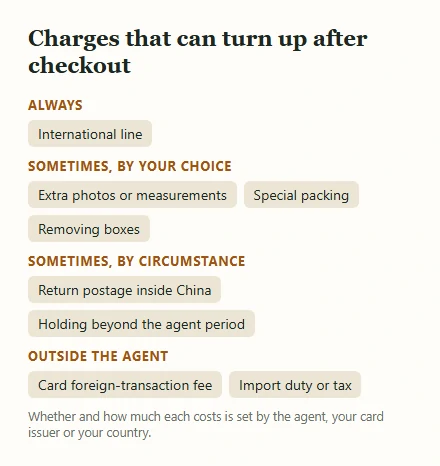
Weeks later, once your items have arrived, passed their photos and been packed, you pay for the international line. That price depends on the finished parcel's weight and size, the line you pick and the destination, which is why nobody can tell you the shipping cost of an item on its own. Optional extras chosen at packing time, such as extra protection or removing shoe boxes, are paid here too.
After the parcel lands
Import duty and tax, where your country charges them, are collected by your customs authority or the delivering carrier. The agent does not set them and cannot waive them. Read the lines and weight page for where to look up your own country's rules.
Converting yuan prices into your own currency
Catalogue cards and Chinese listings price everything in yuan (CNY, written ¥). CNFans's saved pages from August 2026 show a currency switch set to US dollars, which means the agent converts for you and displays the result. Whatever rate it uses becomes part of your cost, alongside any service fee, so it is worth checking how far that rate sits from the market rate on the day you pay.
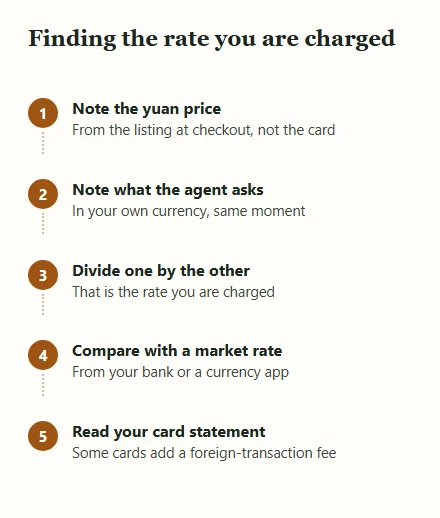
The check takes a minute. Note the yuan price of the item, note the amount the agent asks for in your currency, and divide one by the other to get the rate you are being charged. Then compare it with the rate your bank or a currency app shows at the same moment. The gap, expressed as a percentage, is the conversion margin. Card issuers can add their own foreign-transaction fee on top when the charge lands in a currency that is not your card's own, so check that line on your statement too.
We cannot publish CNFans's current rate or margin: they were never captured, and the site is down. When it returns, the method above gives you the figure in your own currency on your own day, which is more useful than any number we could print.
Second payments and late add-ons
First orders feel cheap because the expensive part comes later. The international line is often the largest single charge in a small order, and nobody can price it before the parcel is packed. Set aside money for it from the start rather than treating the first payment as the total.
Other charges can appear between the two payments, depending on the agent's terms: extra photos or measurements beyond the standard set, special packing, returning an item to its seller inside China, or keeping goods in the warehouse after the agent's holding period runs out. None of these is unusual, and none of them is a reason for alarm; they are simply the costs that turn up after checkout, and an agent's fee page should list all of them. Read that page in full when cnfans.com is back, and compare it with the order you are planning.
Then there is your own side: card fees for paying in a foreign currency, and import charges on arrival.
Why the card price is the floor, not the price
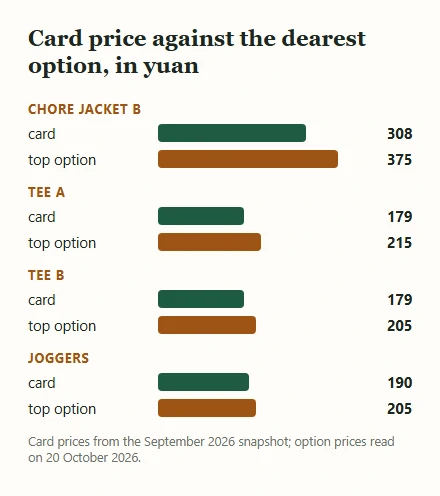
A catalogue card shows one price, and on every listing we checked that price was the cheapest option in the menu. On listings where all options cost the same it is simply the price: the chore jacket at ¥275.00, the jeans at ¥227.00, the perfume at ¥89.00. On listings with differently priced options it is the floor, and what you pay depends on what you pick.
Four listings we read on 20 October 2026 had more than one price. A second chore jacket card showed ¥308.00 and its menu ran to ¥375.00; two plain tee cards showed ¥179.00, with menus topping out at ¥215.00 and ¥205.00; a pair of joggers showed ¥190.00 against a top price of ¥205.00. The differences usually follow size or colour, so check the price after selecting your exact option, and budget from that figure.
Card prices also date from the day the card was refreshed. Treat them as a guide to the price band, then read the live listing.
A useful habit is to write the selected option's price next to the card price in your notes. If the two differ by more than you expected, you have caught the difference before paying rather than on the agent's invoice, and you can decide whether that option is still the one you want.
Keep a price change and a currency change separate
Suppose, purely as an example, the card shows CNY 180 but the chosen colour and size cost CNY 205. Adding CNY 10 domestic delivery gives a CNY 215 purchase subtotal. If your payment screen shows 30 in your currency before a separate payment charge, the observed rate for that subtotal is 30 ÷ 215. It is not automatically the rate a refund or later shipping payment will use.
Save four numbers: selected option price, domestic delivery, amount charged in your currency, and any separately stated fee. When a total changes, first identify which of those numbers moved. Asking “Why is it more?” is less useful than asking whether the option price, conversion or service charge changed.
The international parcel comes later. Keep an allowance for it while shortlisting, then replace the allowance with the actual quote. For a cancellation, request the refund breakdown and check where it is credited; do not assume all top-up charges or completed services will be reversed.