Getting CNFans Spreadsheet finds home: lines, weight and packing
International lines are carrier routes, each setting its own prices, limits and rules about what it will carry. Agents usually offer several, and the right one depends on the parcel you end up with. The archived CNFans footer named DHL, FedEx and China Post among its carriers; which lines it offers to your country, and at what price, can only be read on cnfans.com once the site is back.
Home / Lines and weight
How a shipping line is priced
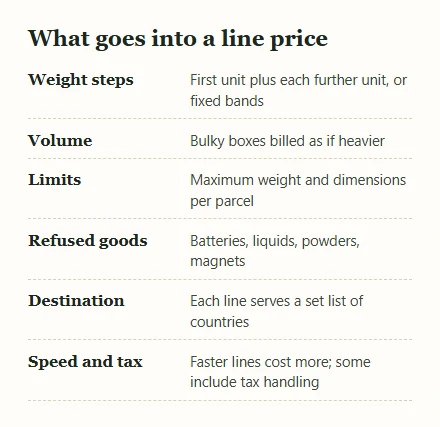
Most lines price by weight in steps: a charge for the first unit of weight and a smaller charge for each further unit, or a fixed price per weight band. A parcel that tips just past a step is charged for all of the next one, which is why removing a shoe box or a heavy hanger sometimes saves more than it seems it should.
Weight is not the only input. Each line has a maximum weight and maximum dimensions, a list of goods it refuses (batteries, liquids, powders and magnets are the usual suspects), and a set of countries it serves. Faster lines generally cost more per unit of weight, and some lines include tax handling at the destination while others leave it to you.
Shipping lines and their shipping costs change often, sometimes weekly. Treat any price you see quoted on a forum as history. The only figure that matters is the one the agent shows for your packed parcel on the day you pay, so compare at least two lines for every parcel rather than defaulting to the one you used last time.
Volumetric weight and bulky but light finds
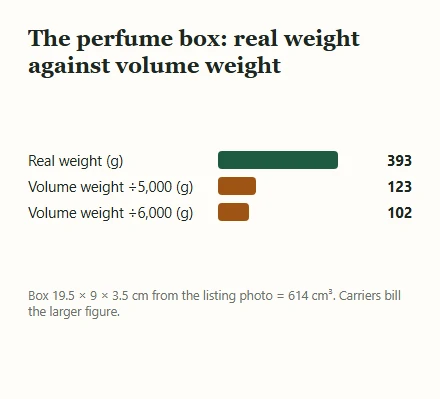
Carriers charge for the space a parcel takes as well as its weight. They multiply length by width by height and divide by a fixed figure set for the line (5,000 and 6,000 are common when the sizes are in centimetres) to get a volumetric weight, then bill whichever is greater: the real weight or the volumetric one.
The perfume on our listing page is a handy worked example, because its photo prints both numbers. A box of 19.5 × 9 × 3.5 cm comes to about 614 cubic centimetres; divided by 5,000 that is roughly 0.12 kg, while the photo gives the weight as 393 g. Real weight wins, so that item bills by weight. A padded jacket is the opposite case: light on the scale, large in the box, and very likely to bill by volume.
That is why packing choices matter. Asking the warehouse to remove shoe boxes or vacuum-pack soft goods reduces volume; whether those services exist and what they cost is in the agent's terms.
Consolidating finds from different shops

Why it saves money
Every parcel pays a first-step charge, so one parcel of four items usually costs less than four parcels of one. Consolidation simply means letting goods from different sellers wait on the warehouse shelf until you request packing. CNFans's August 2026 home page named its last two steps QC&storage and INTL ship, which is this arrangement in two words each.
What it costs you
Time, mainly. Your parcel cannot leave until the slowest seller has delivered and every item has passed its photos. A combined box can also cross a weight or size limit on a cheaper line, pushing you up to a dearer one. Weigh those against the saving before waiting for one more item.
A sensible rhythm
Order the items you want together within a short window, check photos as they arrive, and set a date after which you ship whatever is ready. Items that miss the cut can go in the next parcel. That keeps money from sitting in the warehouse for weeks over one late seller.
Customs and taxation: where to look it up
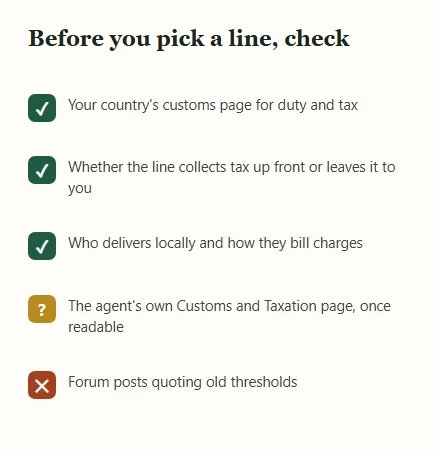
Import duty, VAT or sales tax and handling fees are decided by your own country's rules, not by the agent, and they change. We do not summarise them here because a summary would be out of date somewhere the day it was written. These official pages are where to start:
- United Kingdom: the GOV.UK guidance on goods sent from abroad.
- European Union: VAT on purchases on Your Europe, then your national customs site.
- United States: Internet Purchases from U.S. Customs and Border Protection.
- Canada: Importing by mail from the Canada Border Services Agency.
The archived CNFans help centre listed a page called Customs and Taxation under its Delivery group; read it when the site returns, because it will say which lines include tax handling. Describe the goods in your parcel honestly and accept that charges on arrival are part of the price.
Following the tracking number home
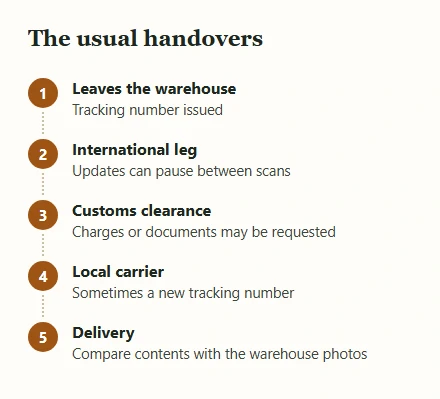
Once you pay for the line, the parcel gets a tracking number. On many lines the international carrier hands the parcel to a local delivery company in your country, and the tracking may switch to a new number or a new website at that point. If updates stop for a while after the parcel leaves China, it is usually in transit between scans rather than lost.
The moments to watch are customs clearance and the first local scan. A parcel held at customs may wait for a payment or a document request from the local carrier, and those requests arrive by text, email or a card through the door. Check that they are genuine by going to the carrier's own website rather than following a link in a message.
Film the unboxing if the items were expensive, and compare what you find with the warehouse photos. If something is missing or damaged in transit, the agent is the first point of contact, and the photos taken before shipping are your evidence.