
Choosing sellers for CNFans Spreadsheet finds from what a shop shows in public
On 20 October 2026 we opened two listings from this site, the chore jacket and the stacked rings, on a phone-sized browser without logging in, then followed each one to its shop page. Everything below comes from those two visits. We do not name the shops; the point is what any shop page lets you see, because choosing a seller is mostly a matter of reading that page well.
Home / Sellers
Signals a shop page gives a visitor without an account
A Weidian listing shows more to a stranger than most buyers expect. On both listings we saw the price, a sales count (1 for the jacket, 0 for the rings), the number of gallery photos (seven and six), the number of option combinations (twelve and eight) and a small panel about the shop: how recently the owner logged in, how many people follow the shop, a return-customer rate and a dispatch promise. The jacket's shop said it ships within 72 hours; the ring shop said three to four days.
Under that panel sit the shop's badges. Ours included 交易资金担保 (payment held by the platform until delivery is confirmed), 企业店 (a shop registered to a business) and, on one of them, 店长实名认证 (owner identity verified). One click further, the shop page adds the city where the shop is registered and its other listings. None of this needs an account, and the agent can see the same panel, so it is fair to ask them about anything that looks odd.
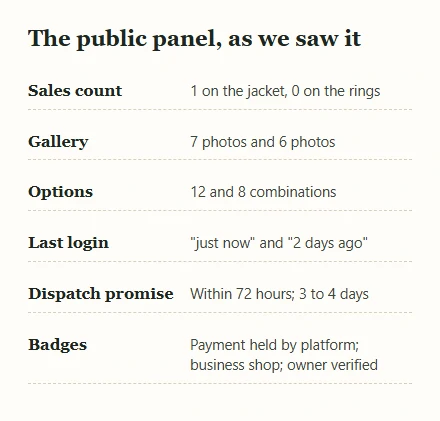
Photo consistency across one shop
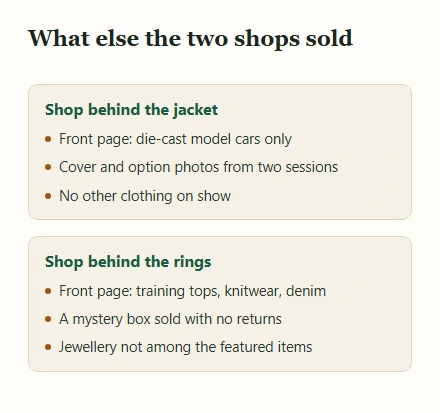
The most telling thing on a shop page is what else the shop sells. The jacket listing belongs to a shop whose front page, when we opened it, was entirely die-cast model cars. The ring listing belongs to a shop whose front page mixed football training tops, knitwear, denim and a mystery clothing box. Neither fact proves anything about the jacket or the rings, but both tell you the seller is not a specialist in what you are buying, and that the listing photos may well come from somewhere else.
So compare photo styles. A specialist shop tends to shoot its items the same way: one backdrop, one light, back views and close-ups throughout. A shop that resells other people's stock shows a patchwork of backdrops and watermarks. The jacket listing itself showed this in miniature: its cover was shot on a wooden floor and its option photos on a paper backdrop in sunlight, two different sessions for one product. That is common and not damning, but it means the warehouse photo is the first picture taken of your unit, and you should read it closely.
Option menus that show how a seller works
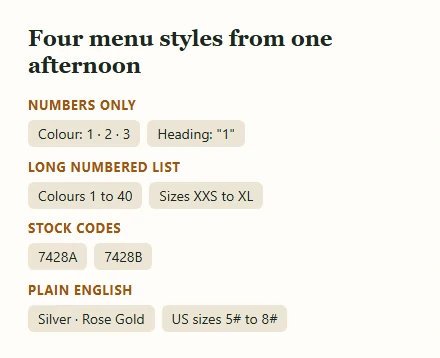
An option menu is written by the seller, and its style says a lot. Careful sellers name colours and give sizes with measurements. Many simply number everything: the jacket's colours are 1, 2 and 3 under a heading that just reads 1
, and the joggers we read offer forty numbered colours. A perfume listing used stock codes, 7428A and 7428B. A ring listing wrote its options in English with US sizes. None of these is wrong, but each tells you how much interpretation you will need to do.
Prices across a menu matter too. On four of the listings we read, different options carried different prices (the widest ran from ¥308.00 to ¥375.00 on one jacket), while the card showed only the lowest. A seller who prices options differently is usually reflecting real differences in cost, such as larger sizes or a different fabric, so check what the extra money buys before assuming the card price applies to you.
When to walk away from a shop
Signs we would act on
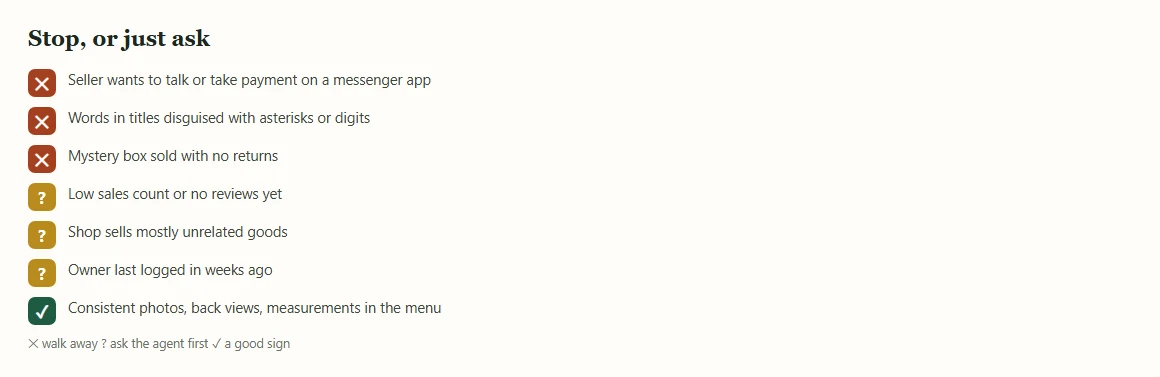
Walk away from a shop that asks you to move the conversation to WhatsApp or another messenger; one of the two shop pages we opened carried a messenger contact on its front page. Payments and promises made off the platform lose the protection of 交易资金担保. Walk away, too, from titles with letters swapped for asterisks or numbers: a seller who disguises words in titles is hiding something from someone, and you cannot know who. And be wary of anything sold as a mystery box with no returns, since there is nothing to check a warehouse photo against.
Signs that only call for questions
A low sales count, a stock photo or an unrelated shop range are reasons to ask, not to leave. Ask the agent for extra photos, compare the measurements with a garment you own, and look at the shop's last login: a shop whose owner has not logged in for weeks may not dispatch at all. A coupon banner offering ¥100 off appeared on both listings we opened while logged out; treat banners like that as platform marketing, not as part of the price.